
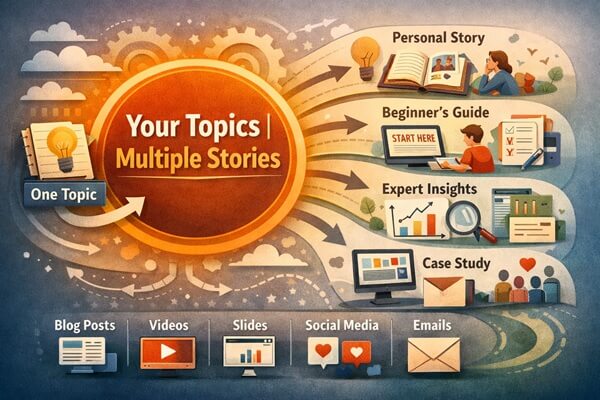
Introduction: One Topic, One Story? Nah, Let’s Do Better
Let me guess. You have written a solid piece of content before, hit publish, and then thought, Okay… now what? I have been there. Too many times. That exact frustration pushed me toward the idea of your topics | multiple stories, and honestly, I have not looked back since.
Here is the deal. One topic can carry way more weight than you think. You do not need new ideas every single day. You need new angles. And once you get this, content creation stops feeling like a grind and starts feeling like a fun conversation. Sounds good, right?
Contents
- 1 What “Your Topics | Multiple Stories” Actually Means
- 2 Why One Topic Deserves More Than One Story
- 3 The Real Power of Multi Narrative Content
- 4 How I Personally Use “Your Topics | Multiple Stories”
- 5 Different Types of Stories You Can Tell From One Topic
- 6 Turning One Topic Into Multiple Content Formats
- 7 Storytelling vs Plain Explanation
- 8 Using Humor Without Overdoing It
- 9 Common Mistakes People Make With Multiple Stories
- 10 Why This Strategy Works So Well for Brands and Creators
- 11 Applying “Your Topics | Multiple Stories” to Marketing
- 12 Using Stories to Guide the Reader’s Journey
- 13 A Simple Framework You Can Use Immediately
- 14 Why Readers Love This Without Realizing It
- 15 SEO Without Sounding Like a Robot
- 16 When You Should Not Use Multiple Stories
- 17 How This Changes the Way You Think About Ideas
- 18 Final Thoughts: One Topic, Infinite Possibilities
- 18.1 FAQs:
- 18.2 What does “your topics | multiple stories” mean?
- 18.3 Why is the multiple stories approach effective for content creation?
- 18.4 How does “your topics | multiple stories” help with SEO?
- 18.5 Can beginners use the multiple stories method?
- 18.6 How many stories should I create for one topic?
- 18.7 Is this approach useful for businesses and brands?
- 18.8 Does this strategy work on social media too?
- 18.9 When should I avoid using multiple stories?
What “Your Topics | Multiple Stories” Actually Means
At its core, your topics | multiple stories means taking one core topic and telling several different stories around it. Each story highlights a new perspective, emotion, or use case. Same topic. Fresh vibe.
Think of it like this. You do not watch one movie and say, “Cool, I am done with films forever.” You enjoy different stories, even if they share similar themes. Why should content work any differently?
IMO, this mindset flips the entire content game.
Why One Topic Deserves More Than One Story
Because People Do Not All Think the Same Way
Some readers love data. Some love emotions. Others just want quick takeaways. Multiple stories let you talk to all of them without changing your main topic.
Ever noticed how one blog post connects deeply with someone, while another barely registers? That is not random. That is perspective at work.
Because Repetition With Variety Actually Works
Repetition scares people. Variety does not. When you explain the same idea through different stories, people remember it better.
And yes, search engines notice too. FYI.
The Real Power of Multi Narrative Content
It Turns Content Into an Experience
Plain facts inform. Stories connect. When you wrap ideas in narratives, readers stick around longer, nod their heads, and think, Yep, that makes sense.
I have personally seen higher engagement when I stopped explaining and started storytelling. Coincidence? I doubt it.
It Makes Complex Ideas Feel Simple
Ever tried explaining something technical and watched eyes glaze over? Same here. Stories solve that problem fast.
A scenario, a character, a challenge. Suddenly the idea clicks. And once it clicks, it sticks.
How I Personally Use “Your Topics | Multiple Stories”
Let me get real for a second. When I plan content now, I do not ask, What should I write next?
I ask, What other story can this topic tell?
That small shift saves time, boosts creativity, and keeps content consistent.
My Simple Planning Method
Here is what I usually do:
-
Pick one main topic
-
List five to seven angles or perspectives
-
Turn each angle into its own story or piece of content
That is it. No fancy tools. No overthinking.
Different Types of Stories You Can Tell From One Topic
The Personal Story
This one hits hard. Share a real experience. Wins, failures, lessons. People love authenticity.
Readers trust humans more than polished perfection. Always.
The Beginner’s Story
Explain the topic as if someone just discovered it yesterday. This pulls in newcomers and builds authority fast.
Ever wondered why beginner guides rank so well? Now you know.
The Expert’s Perspective
Flip the switch and go deeper. Share advanced insights, mistakes to avoid, or insider tips.
This story reassures experienced readers that you know your stuff.
Turning One Topic Into Multiple Content Formats
Here is where things get fun.
Same Topic, Different Formats
You can stretch one idea across:
-
Case studies
-
Slides
-
Short videos
-
Social media threads
-
Email stories
Same core message. New wrapper every time. Efficient? Absolutely.
Why This Boosts SEO Naturally
Search engines love depth. When you cover a topic from multiple angles, you create a content cluster without forcing keywords everywhere.
That is smart SEO, not spammy SEO.
Storytelling vs Plain Explanation
Let us compare honestly.
Plain explanation
-
Fast
-
Clear
-
Forgettable
Story driven content
-
Relatable
-
Emotional
-
Memorable
Which one do you remember tomorrow? Exactly.
Using Humor Without Overdoing It
I like humor. You probably do too. But balance matters.
A light joke here. A playful line there. Never force it.
If you sound like you are trying too hard, readers notice. And not in a good way.
Common Mistakes People Make With Multiple Stories
Trying to Say Everything at Once
Each story needs one clear point. Do not cram five lessons into one narrative. That just confuses people.
Repeating the Same Angle
Different story does not mean rewritten intro. Change the lens. Change the emotion. Change the outcome.
If it feels repetitive to you, it definitely feels repetitive to the reader.
Why This Strategy Works So Well for Brands and Creators
It Builds Authority Without Shouting
When people see you cover a topic deeply, they assume expertise. You do not need to say, I am an expert. Your stories say it for you.
It Creates Long Term Content Assets
Trendy content fades fast. Story based content lasts because humans do not outgrow stories.
Ever rewatched an old movie? Exactly.
Applying “Your Topics | Multiple Stories” to Marketing
Content Marketing
Brands use this approach to:
-
Educate
-
Entertain
-
Build trust
All without sounding salesy. That is a win.
Social Media
Short stories work extremely well on social platforms. One topic can fuel weeks of posts if you switch angles smartly.
Why post once when you can post smarter?
Using Stories to Guide the Reader’s Journey
Every story should move the reader somewhere.
Ask yourself:
-
What should they feel?
-
What should they learn?
-
What should they do next?
When stories guide action, content stops being noise and starts being influence.
A Simple Framework You Can Use Immediately
Here is a framework I use all the time:
-
Topic – the main idea
-
Angle – emotional, practical, or analytical
-
Story – real, hypothetical, or case based
-
Lesson – one clear takeaway
Repeat this with different angles, and you have a content machine.
Why Readers Love This Without Realizing It
Readers do not think, Wow, this uses multiple narratives.
They think, This feels easy to read.
That is the magic.
When content feels natural, people stay longer, share more, and come back. Metrics love that too.
SEO Without Sounding Like a Robot
Let us be honest. Keyword stuffing feels awful.
With your topics | multiple stories, keywords appear naturally because you talk about the topic in depth. You do not force relevance. You earn it.
Search engines reward that. Readers appreciate it.
When You Should Not Use Multiple Stories
Yes, this matters.
If the topic needs a direct answer, skip the stories. FAQs, definitions, or urgent how to guides sometimes need speed over depth.
Use the right tool for the job.
How This Changes the Way You Think About Ideas
Once you adopt this approach, something interesting happens.
You stop saying,
“I have run out of ideas.”
And start saying,
“Which angle should I explore next?”
That mindset shift alone makes content creation far less stressful.
Final Thoughts: One Topic, Infinite Possibilities
Let us wrap this up cleanly.
Your topics | multiple stories is not a trick. It is a mindset. It helps you write better, connect deeper, and work smarter.
You already have topics worth sharing. You just need to tell their other stories.
Next time you finish a piece of content, pause and ask yourself:
What is the other story hiding here?
You will find it. And once you do, content creation gets a lot more fun.
FAQs:
What does “your topics | multiple stories” mean?
Your topics | multiple stories means creating multiple narratives from a single topic instead of explaining it just once. You keep the core idea the same, but you explore it through different angles like personal experiences, beginner guides, expert insights, or real world examples. This approach keeps content fresh without constantly hunting for new topics.
Why is the multiple stories approach effective for content creation?
This approach works because people connect with stories, not just information. Different readers relate to different perspectives. When you tell multiple stories around one topic, you increase engagement, improve understanding, and keep readers on your content longer. Search engines also reward this depth.
How does “your topics | multiple stories” help with SEO?
It helps SEO by naturally expanding topical coverage. You rank for more related keywords without stuffing them. Multiple stories create internal linking opportunities, stronger topical authority, and better user engagement, which search engines love.
Can beginners use the multiple stories method?
Absolutely. Beginners benefit the most from it. You do not need advanced writing skills. You only need one topic and curiosity. Start with simple stories like how you learned something, mistakes you made, or lessons you discovered along the way.
How many stories should I create for one topic?
There is no fixed number, but three to seven stories per topic works well. This gives you enough variety without overwhelming readers. You can always add more stories later as your understanding grows.
Is this approach useful for businesses and brands?
Yes, especially for brands. Businesses use your topics | multiple stories to educate customers, build trust, and communicate value without sounding sales driven. Each story can target a different customer pain point while reinforcing the same core message.
It works extremely well on social media. One topic can generate weeks of posts by switching angles. Short stories, lessons learned, or customer scenarios perform better than repetitive promotional content.
When should I avoid using multiple stories?
Avoid it when users need quick, direct answers, such as definitions, FAQs, or urgent how to guides. In those cases, clarity and speed matter more than storytelling.

