
Introduction: That Moment When a Career Page Just… Vanishes
You click a company’s “Careers” link, ready to browse jobs or maybe even apply, and instead of listings, you get hit with a confusing message: “Keine Karriere-Subdomain gefunden.” If that phrase made you pause and squint at your screen, you’re not alone. The first time I saw it, I honestly wondered if I had broken the internet or accidentally wandered into a developer only zone.
Spoiler alert: you didn’t mess anything up. This message pops up more often than you’d think, and it has a surprisingly simple explanation once you unpack it. So let’s talk it through.
Contents
- 1 What Does “Keine Karriere-Subdomain Gefunden” Actually Mean?
- 2 Why This Message Appears in the First Place
- 3 Why You See It Mostly on Career Pages
- 4 Is This Error Your Fault? Short Answer: No
- 5 Why This Message Confuses So Many People
- 6 What Job Seekers Should Do When They See This
- 7 What This Error Means for Companies and Employers
- 8 SEO Impact of “Keine Karriere-Subdomain Gefunden”
- 9 How Website Owners Can Fix This Issue
- 10 Why This Error Shows Up So Often on Modern Websites
- 11 Is This a Security Warning? No, and That’s Important
- 12 Why the Message Appears in German
- 13 Real World Example: When This Happened to Me
- 14 Common Misunderstandings About This Error
- 15 How Companies Can Prevent This From Happening Again
- 16 Why Clear Error Handling Matters
- 17 What This Message Says About Modern Web Design
- 18 When You Can Safely Ignore This Message
- 19 The Bigger Picture: User Experience Always Wins
- 20 Final Thoughts: Confusing Message, Simple Meaning
What Does “Keine Karriere-Subdomain Gefunden” Actually Mean?
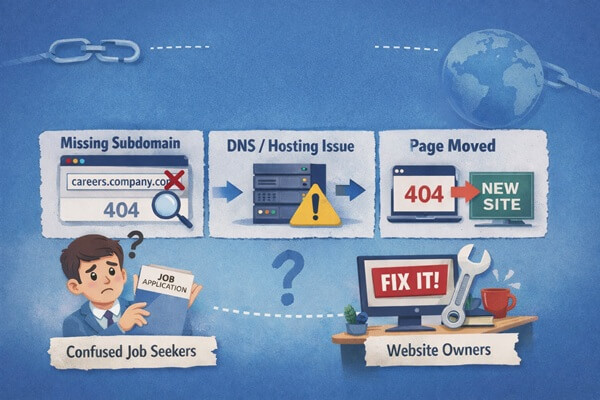
“Keine Karriere-Subdomain gefunden” is German and translates directly to “no career subdomain found.” In practical terms, the website expected to load a careers or jobs page from a specific subdomain, but that subdomain did not exist or failed to respond.
You can think of it like knocking on a door that was planned but never installed. You’re in the right place, but the entry point simply isn’t there. Importantly, this message comes from the website or platform itself, not from your browser.
Why This Message Appears in the First Place
This message does not appear randomly. It shows up because of predictable technical reasons tied to how websites manage career pages and subdomains.
Common Causes at a Glance
| Cause | What Actually Happens |
|---|---|
| Missing subdomain | The careers subdomain was never created |
| Renamed subdomain | The old careers link points nowhere |
| DNS misconfiguration | The subdomain exists but doesn’t route correctly |
| Hosting mismatch | Server doesn’t serve content for that subdomain |
Each of these situations leads the system to look for something that simply isn’t there.
Why You See It Mostly on Career Pages
Career pages often live on separate systems from the main website. Many companies use third-party hiring platforms that rely on subdomains. When those integrations fail or remain incomplete, the careers section breaks while the rest of the site works normally.
That’s why you can browse products and blog posts without issues, then suddenly hit a wall when clicking “Jobs.”
Is This Error Your Fault? Short Answer: No
This error is not caused by your device, browser, network, or location. Refreshing the page or switching browsers won’t fix it. The problem exists entirely on the website’s backend.
That’s actually good news, because it means there’s nothing you did wrong.
Why This Message Confuses So Many People
The wording feels technical and intimidating. Unlike common browser errors, it doesn’t explain what went wrong or what to do next. Many users assume the company stopped hiring or that the website is broken entirely.
In reality, the system simply couldn’t find the career subdomain it expected.
What Job Seekers Should Do When They See This
Seeing Keine Karriere-Subdomain Gefunden does not mean there are no open roles. It just means that one specific path failed.
Practical Next Steps for Job Seekers
| Action | Why It Helps |
|---|---|
| Visit homepage | Career page may live under a normal URL |
| Google “Company + careers” | Often reveals the active page |
| Check LinkedIn or Indeed | Many companies list roles externally |
| Look for footer links | Sometimes careers live there |
These steps usually lead to the correct job listings quickly.
What This Error Means for Companies and Employers
From a company’s perspective, this error creates friction at the worst possible moment. Job seekers who hit dead ends often leave without trying again.
A broken career subdomain can lead to lost applications, weaker employer branding, and lower trust. IMO, it’s one of the easiest technical issues to underestimate.
SEO Impact of “Keine Karriere-Subdomain Gefunden”
Search engines dislike unresolved paths. When crawlers encounter a missing career subdomain, they may drop job pages from indexing or reduce trust in the site’s structure.
SEO Consequences Overview
| Issue | SEO Impact |
|---|---|
| Broken career URLs | Lost job page visibility |
| Crawl errors | Reduced crawl efficiency |
| Missing redirects | Ranking loss over time |
This affects both organic traffic and recruitment reach.
How Website Owners Can Fix This Issue
Fixing this problem usually doesn’t require a full redesign. Most solutions focus on configuration.
Common Fixes and Their Purpose
| Fix | Purpose |
|---|---|
| Create subdomain | Matches platform expectations |
| Update DNS records | Routes traffic correctly |
| Add redirects | Prevents dead ends |
| Install SSL | Ensures secure access |
Even a simple redirect can dramatically improve user experience.
Why This Error Shows Up So Often on Modern Websites
Modern websites rely on many interconnected tools. HR platforms, CMS systems, and hosting environments must align perfectly. When one piece breaks, this message appears.
I’ve noticed it shows up most often during redesigns, migrations, and unfinished setups.
Is This a Security Warning? No, and That’s Important
Despite how technical it looks, this is not a security warning. It does not indicate malware, hacking, or unsafe browsing. It simply signals a missing configuration.
Think of it as a broken sign, not a locked gate.
Why the Message Appears in German
Many recruiting platforms originate in German-speaking regions. When they fail to load properly, they display default system messages instead of localized ones.
That language mismatch adds confusion but doesn’t change the meaning.
Real World Example: When This Happened to Me
I once clicked a careers link that led straight to this message. I almost closed the tab. Instead, I searched manually and found active job listings elsewhere.
The company was hiring aggressively, but their career subdomain was broken. That’s how easily opportunities disappear.
Also read: Sofoximmo: Smart Real Estate Insights for Buyers & Investors
Common Misunderstandings About This Error
People often assume the company stopped hiring or that they lack access. Neither is true. The message only means the career subdomain didn’t resolve.
Understanding that difference saves a lot of frustration.
How Companies Can Prevent This From Happening Again
Regular testing, proper redirects, and monitoring DNS changes prevent this issue. Websites work best when career paths stay simple and predictable.
Prevention always beats cleanup.
Why Clear Error Handling Matters
If an error must appear, it should guide users. A simple explanation and a fallback link would prevent confusion entirely.
Instead, users see a technical phrase with no next step.
What This Message Says About Modern Web Design
This error highlights how fragile complex systems can be. One missing configuration can block something as critical as hiring.
Clear paths always outperform clever architecture.
When You Can Safely Ignore This Message
As a user, you can ignore the message and look for another route. As a site owner, you should never ignore it.
The Bigger Picture: User Experience Always Wins
Users don’t care how things are built. They care whether things work. Career pages deserve the same attention as homepages.
Final Thoughts: Confusing Message, Simple Meaning
Keine Karriere-Subdomain Gefunden sounds intimidating, but it means one simple thing: the site couldn’t find a career subdomain. That’s all.
For job seekers, it’s a detour. For companies, it’s a fixable issue. And once you understand it, the message loses all its mystery.
Next time you see it, you’ll know exactly what’s happening—and that confidence feels pretty good.

