
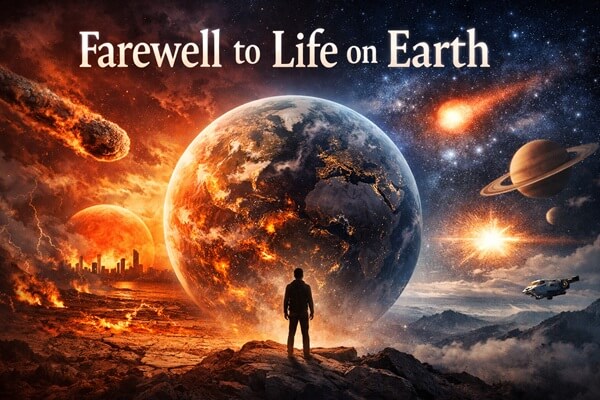
Ever caught yourself staring at the night sky and thinking, “Well… how does all this end?”
Yeah, same here. One random night, coffee in hand, doom scrolling space articles, I stumbled into the idea of “Farewell to Life on Earth.” Not in a panic-inducing, asteroid is coming tomorrow way but in a strange, thoughtful, oddly calming way.
This article isn’t about fear-mongering. It’s about understanding, wondering, and maybe even appreciating life a bit more once you realize it doesn’t last forever. Heavy topic? Sure. Depressing? Not really. Stick with me.
Contents
- 1 Why “Farewell to Life on Earth” Even Exists as an Idea
- 2 The Science Part (Don’t Worry, I’ll Keep It Friendly)
- 3 Asteroids, Supernovae, and Other Space Horror Stories
- 4 The Philosophical Side: Why This Idea Hits So Hard
- 5 Humans, Technology, and the Long Goodbye
- 6 Could Humanity Outgrow Earth?
- 7 Why Thinking About the End Makes Life Better
- 8 What the References Really Point Toward
- 9 Key Takeaways
- 10 So… Should We Be Worried?
- 11 Final Thoughts: A Friendly Goodbye That Isn’t Here Yet
Why “Farewell to Life on Earth” Even Exists as an Idea
Let’s get one thing straight first.
Earth isn’t about to explode tomorrow. No alarm clocks needed.
But humans love asking big questions. And one of the biggest is this: What happens when life on Earth eventually ends?
We ask this question because:
-
We love cosmic drama (don’t lie).
-
Science keeps uncovering uncomfortable truths.
-
Thinking about endings weirdly helps us understand beginnings.
IMO, this curiosity doesn’t signal fear. It signals maturity.
The Science Part (Don’t Worry, I’ll Keep It Friendly)
The Sun: Our Best Friend… With an Expiry Date
Let’s talk about the biggest elephant in the cosmic room: the Sun.
The Sun won’t betray us anytime soon, but in about 5 billion years, it will:
-
Expand into a red giant
-
Heat Earth beyond habitability
-
Eventually erase all known life
Sounds dramatic, right? It is. But also very, very slow.
Key takeaway:
The Sun guarantees a farewell to life on Earth but not on any human timeline.
So yeah, cancel your apocalypse bunker plans.
Rogue Stars and Runaway Space Drama
Some references mention runaway stars drifting through space like cosmic rebels without a cause.
Could a passing star mess with Earth’s orbit?
Technically yes.
Practically? Extremely unlikely.
For a star to:
-
Kick Earth out of orbit
-
Or fling it into deep space
…it would need to pass insanely close. And space, FYI, is huge. Like, absurdly huge.
Translation:
Possible in theory.
Not happening anytime soon.
Internet headlines exaggerate this stuff. A lot.
Asteroids, Supernovae, and Other Space Horror Stories
Let’s speed run the usual suspects.
Asteroids
-
NASA tracks near-Earth objects constantly
-
We spot dangerous ones decades in advance
-
Planetary defense is an actual thing now
Supernovae
-
A nearby supernova could harm Earth
-
No known star close enough poses an immediate risk
Bottom line:
These threats exist.
None scream “pack your bags” today.
The Philosophical Side: Why This Idea Hits So Hard
Now let’s switch gears. This is where things get interesting.
When people say “Farewell to Life on Earth,” they don’t always mean literal extinction. Sometimes, they mean:
-
The end of our version of Earth
-
The loss of ecosystems
-
The consequences of climate damage
-
Or simply human mortality projected onto a planet
Ever noticed how thinking about endings makes moments feel sharper?
Yeah. Same energy.
Climate Change: The Self Inflicted Plot Twist
Unlike rogue stars, climate change actually sits in our hands.
We already see:
-
Rising temperatures
-
Species extinction
-
Ocean acidification
Will this wipe out all life? No.
Will it radically change life as we know it? Absolutely.
That’s where “farewell” becomes metaphorical.
We may not lose Earth but we could lose this version of it.
Kind of sobering, right?
Humans, Technology, and the Long Goodbye
Here’s a wild thought: what if life doesn’t end… it just moves?
Humans already explore:
-
Space colonization
-
Artificial habitats
-
AI-assisted survival
Maybe Earth gets a farewell party, not a funeral.
I like that idea better.
Could Humanity Outgrow Earth?
Some scientists believe humanity might:
-
Leave Earth behind
-
Spread across space
-
Treat Earth as a birthplace, not a forever home
Sounds sci-fi, but so did smartphones once.
Questions worth asking:
-
Will humans still be “human” off-Earth?
-
Does life need Earth, or just conditions?
-
Is Earth the start or the center?
No clear answers. Just fascinating questions.
Why Thinking About the End Makes Life Better
Here’s the twist no one warns you about.
Thinking about the end of life on Earth doesn’t make life meaningless.
It actually does the opposite.
It reminds you that:
-
Time matters
-
Choices matter
-
This moment matters
When something doesn’t last forever, it becomes precious.
Ever wondered why sunsets feel emotional?
Yeah. Same principle.
What the References Really Point Toward
After reading all those sources, one thing became clear to me.
They don’t scream doom.
They whisper perspective.
They suggest:
-
Science explains the how
-
Philosophy explores the why
-
Humanity decides the what next
And honestly? That combo feels empowering.
Key Takeaways
Let’s wrap the big ideas neatly:
-
Life on Earth will end someday, but not soon
-
Cosmic threats exist, but most stay theoretical
-
Climate change is the most immediate concern
-
Human curiosity drives these questions
-
Thinking about endings adds meaning to living
Bold truth: The idea of farewell doesn’t mean goodbye today.
So… Should We Be Worried?
Short answer: No.
Longer answer:
We should stay curious, responsible, and aware without spiraling into fear.
The universe doesn’t rush.
Neither should we.
Final Thoughts: A Friendly Goodbye That Isn’t Here Yet
If Earth could talk, I don’t think it would say goodbye right now.
It would probably say:
“Relax. Take care of me. Enjoy the ride.”
And honestly? That feels like solid advice.
So next time you hear “Farewell to Life on Earth,” don’t panic.
Think. Reflect. Appreciate.

