
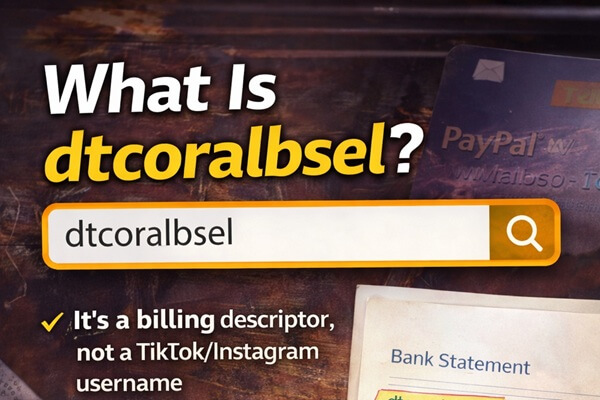
You’re here because you saw dtcoralbsel somewhere strange. Maybe it popped up on your bank statement. Maybe PayPal showed it as a transaction name. Or maybe Google suggested it, and curiosity got the better of you. Either way, you’re not alone—and no, you didn’t accidentally discover a secret influencer or underground brand.
I’ve been down this rabbit hole myself. The first time I saw a weird billing name, my brain instantly went into detective mode. Did I subscribe to something at 3 a.m.? Did my card get hacked? Is this a person, a company, or a typo? Let’s clear the confusion once and for all.
Contents
- 1 What Exactly Is dtcoralbsel?
- 2 Why dtcoralbsel Looks So Confusing
- 3 Where People Usually See dtcoralbsel
- 4 Is dtcoralbsel a Scam?
- 5 What Type of Charges Use dtcoralbsel?
- 6 Why dtcoralbsel Doesn’t Show a Business Name
- 7 Why People Think dtcoralbsel Is an Influencer
- 8 How to Identify the Real Source of the Charge
- 9 Should You Cancel or Dispute a dtcoralbsel Charge?
- 10 Why So Many Websites Get dtcoralbsel Wrong
- 11 dtcoralbsel vs Real Billing Names
- 12 Why Billing Descriptors Matter More Than Ever
- 13 Can dtcoralbsel Appear Again?
- 14 What dtcoralbsel Is NOT
- 15 Why Google Searches for dtcoralbsel Keep Growing
- 16 How to Avoid Confusing Charges in the Future
- 17 Final Thoughts on dtcoralbsel
What Exactly Is dtcoralbsel?
Let’s start with the most important thing, because this clears up 90% of the confusion.
dtcoralbsel is not a person, influencer, brand, or social media account.
It’s a billing descriptor a technical label used by payment processors to identify certain transactions.
That’s it. No Instagram fame. No TikTok following. No secret online personality hiding in plain sight.
Ever noticed how some charges on your bank statement look normal while others look like keyboard smashes? dtcoralbsel falls into the second category.
Why dtcoralbsel Looks So Confusing
Here’s the funny part. dtcoralbsel looks like a username, and our brains automatically assume usernames belong to people.
That reaction makes sense. We live in a world where:
-
Random strings often equal social handles
-
Short names usually point to brands
-
Weird words often mean “internet thing”
But dtcoralbsel doesn’t play by those rules. It exists purely for backend financial systems, not humans scrolling social feeds.
IMO, banks could do a much better job making these labels readable. But here we are.
Where People Usually See dtcoralbsel
Most people don’t randomly search this term for fun. They search it because they see it somewhere important.
You’ll usually spot dtcoralbsel in places like:
-
Bank statements
-
Credit card transaction histories
-
PayPal or digital wallet records
-
Subscription billing summaries
Ever scanned your statement and thought, “I don’t remember buying this”? That moment usually sends people straight to Google.
Is dtcoralbsel a Scam?
This question comes up a lot, and I get why. Anything unfamiliar near your money feels suspicious.
dtcoralbsel itself is not a scam.
It’s a neutral billing identifier used by payment processors.
That said, the transaction behind it might still be something you forgot, misunderstood, or no longer want. The label doesn’t tell the full story. It just points to a payment event.
Think of it like a nickname your bank uses internally. It doesn’t explain why the charge exists it just labels it.
What Type of Charges Use dtcoralbsel?
Based on patterns and user reports, dtcoralbsel often appears with digital or automated payments.
Common examples include:
-
Online subscriptions
-
Digital tools or services
-
Membership platforms
-
One-time online purchases
Ever signed up for a free trial and forgot to cancel? Yeah… that’s how most of these stories start.
Why dtcoralbsel Doesn’t Show a Business Name
Here’s where things get annoying.
Some companies use third party payment processors, and those processors control how charges appear on statements. Instead of showing a clean business name, the system displays a processor-generated code like dtcoralbsel.
So even if you paid a real service, your bank might not show that service’s name clearly.
FYI, this happens more often than people realize.
Why People Think dtcoralbsel Is an Influencer
This one always makes me laugh a little.
People assume dtcoralbsel belongs to:
-
An Instagram model
-
A TikTok creator
-
A crypto account
-
A dropshipping brand
Why? Because the name looks like it fits that vibe.
But every serious lookup leads to the same conclusion: no verified social media presence exists under that name. No blue checks. No follower counts. No content trail.
If dtcoralbsel were a real person, the internet would have receipts by now.
How to Identify the Real Source of the Charge
This part matters the most if you’re worried about your money.
Here’s how I personally handle weird billing names like dtcoralbsel:
Step 1: Check the Amount and Date
Small recurring charges usually point to subscriptions. One-time larger charges often tie to purchases.
Step 2: Search Your Email
Look for receipts around the same date. Keywords like “welcome,” “subscription,” or “payment confirmation” help a lot.
Step 3: Review Your App History
Check apps or services you recently tried. Trials love to turn into charges.
Step 4: Contact Your Bank or PayPal
They can often tell you the merchant category or processor behind the charge.
Nine times out of ten, this solves the mystery.
Should You Cancel or Dispute a dtcoralbsel Charge?
That depends on what you discover.
You should cancel the service if:
-
You recognize the charge
-
You no longer want the subscription
-
The charge matches something you signed up for
You should dispute the charge if:
-
You can’t identify the service
-
You never authorized the payment
-
The charge repeats unexpectedly
Trust your instincts here. If something feels off, act on it.
Why So Many Websites Get dtcoralbsel Wrong
Here’s where things get messy online.
Some websites label dtcoralbsel as:
-
A “social media personality”
-
A “trending influencer”
-
A “new online brand”
Those claims fall apart under scrutiny. They usually recycle speculation without proof. They confuse search trends with real identities.
Search volume doesn’t equal legitimacy. That’s an important internet lesson.
dtcoralbsel vs Real Billing Names
Let’s compare dtcoralbsel to clear billing labels.
Clear billing name:
-
Netflix
-
Spotify
-
Amazon
Unclear billing name:
-
dtcoralbsel
-
random strings
-
processor codes
The difference isn’t intent it’s transparency.
Both can represent legitimate charges. One just explains itself better.
Why Billing Descriptors Matter More Than Ever
As online payments grow, these identifiers show up more often.
People now:
-
Subscribe faster
-
Click checkout quicker
-
Forget purchases easier
That combo creates confusion when billing labels don’t match expectations. dtcoralbsel sits right in the middle of that problem.
IMO, payment systems need to catch up with user clarity.
Can dtcoralbsel Appear Again?
Yes, and that’s important.
If dtcoralbsel ties to:
-
A recurring subscription
-
A monthly service
-
An annual renewal
Then you’ll see it again until you cancel or the subscription ends.
If you only see it once, it was likely a one time charge.
What dtcoralbsel Is NOT
Let’s lock this in clearly.
dtcoralbsel is not:
-
A celebrity
-
An influencer
-
A TikTok account
-
An Instagram model
-
A crypto token
-
A public brand
Sometimes clarity comes from ruling things out.
Why Google Searches for dtcoralbsel Keep Growing
People don’t search this term because it’s exciting. They search it because money triggers curiosity and concern.
Every unfamiliar charge creates:
-
Anxiety
-
Questions
-
Urgency
Google becomes the first stop. You ended up here for the same reason thousands of others did.
How to Avoid Confusing Charges in the Future
I’ve learned this the hard way, so let me save you some time.
Smart habits that help:
-
Screenshot subscription sign-ups
-
Use one email for purchases
-
Review statements monthly
-
Cancel trials immediately after signup
It’s boring advice, but it works.
Final Thoughts on dtcoralbsel
If you came here worried, you can relax a bit. dtcoralbsel itself isn’t dangerous. It’s just a poorly explained billing label that looks way more mysterious than it deserves.
Still, don’t ignore unfamiliar charges. Curiosity protects your wallet. Ask questions. Check receipts. Cancel what you don’t need.
And next time you see a weird name on your statement, you’ll know this trick:
Not everything that looks like a username belongs to a human 🙂

